
Day 61: Finding the thread
meet Jyotsna Ramesh + an opportunity for nature-themed artists


Hello, friends!
I also just want to say thank you for the outpouring of kind words, encouragement, and enthusiasm around the book (ICYMI: I’m writing a book!). It’s meant more than I can say. I’ll be reading through submissions and doing interviews over the next few months, so if this is your first time doing the project and you’re still finding your way through it, you have time to share. Keep going. There are many more days ahead!
→ Are you making plant or nature-themed art for your 100-day project?
There’s an opportunity for you at the bottom of today’s newsletter. Your work could become part of an international science-art intervention happening on May 18th for the Fascination of Plants Day.
For today’s post, I’m passing the baton to Tricia Fell. I’m especially grateful to Trish for taking the lead on this conversation—her questions get right to the heart of what it means to stay with a project over time. Here’s Trish!
Dear Ones,
What if the thing standing between you and your creative practice isn’t discipline—but curiosity? What if it were less about trying harder and more about getting genuinely interested in what the struggle is trying to teach you?
Showing up every day might sound simple, even routine. Showing up imperfectly, persistently, and with compassion for yourself, however? That’s the harder, more honest version.
Jyotsna Ramesh has been there too, and she’s learned to stop seeing any creative project as failure. Now deep into her first graphic novel and navigating a fresh ADHD diagnosis, the Bangalore-based multimedia artist has built something rarer than consistency: a practice with room to breathe. She explores themes of intersectional feminism, queerness, and mental health, weaving personal experience with design thinking to create work that is carefully considered.
She opens up here about failure, flexibility, and what it really means to show up for your work—imperfectly, consistently and with curiosity.
This is your fourth try at The 100 Day Project, and you describe previous ones as “failures,” but you also seem to be reframing what failure even means. How has your relationship with that word changed over the course of these attempts? What’s helped you reframe it?
Yes, this is my fourth attempt at a 100-day project and I cannot count how many attempts in general I have made at daily/weekly scheduled creative projects such as Inktober, Childhood Illustration Week or simply a daily studying/making hour over the last 10+ years. I have rarely finished them, if at all, and until very recently I saw them as “failures.” It’s honestly only now in hindsight that I can view them for what they are: crucial attempts that have taught me so much more about myself and the need for flexibility within structure that my creative practice requires. They’re more valuable in what I learnt of myself than simply what I produced or failed to produce. (And they certainly felt like failures at the time. There was so much shame, disappointment and frustration associated with it—which made me feel worse about how I struggled to follow-through with my creative goals and building the body of work I aspired to make).
I think about this image by Hannah Wilson a LOT—it fundamentally changed how I see consistency, discipline and what showing up means.
I think it’s only now that I’ve realised what it truly means for me to be “consistent” in my practice of any kind and it’s taken years of (ongoing) work in therapy to dismantle the perfectionist’s voice. Start small, continue imperfectly and build resilience for getting back to it when you stop (alternatively redefined as Pause).
Your professor in your Sequential Artists Workshop scholarship course framed an early assignment as gathering data about your process rather than making something “good.” Has that reframe—treating the work as information rather than output—carried into The 100 Day Project itself?
Yes and no. I think for those of us that work in a creative field in any professional capacity or care deeply about the work we make, not just in terms of process and the joy of it but also about what it leads to and how it stands on its own, it’s actually impossible to entirely separate ourselves from the need to make “something good.” I spent a few years struggling with this—where a lot of advice I’d see online was about “stop caring what the outcome looks like,” only care “if you’re having fun and it’s fulfilling.” But for a lot of us, satisfaction comes from making something we’re proud of. I eventually figured it’s counter-intuitive to expect one to separate one’s tastes and training (that pushes us to recognise GOOD work), from the work we produce. I found it futile to fight the need for that end goal. Instead, I’ve tried embracing that I will always strive to produce “good” work by my tastes.
With that discernment, if you keep showing up, you’re bound to hit gold at some point and produce work that is worthy in your own eyes. The biggest challenge then is to ensure you show up resiliently, and the best way to guarantee that is to enjoy the process, approaching all parts of it with compassion and curiosity - - which can help dampen the frustration of the bits you don’t like. Embracing that there’s no wrong or right way to approach the work helps. Reframing with curiosity has been great to discover and gain new information about myself, so that I can have more grace around those parts of the process. I believe curiosity is the antidote to feelings of shame and frustration.
You’ve landed on a process-based project rather than an output-based one, and you credit that partly to your ADHD. Can you walk us through what a typical project day actually looks like for you in this mindset?
Yes, for a couple of reasons all linked to my ADHD traits, I find that daily output-based projects are not for me, and even if I’m working towards a final output, reframing my practice as a process-based project is a key ingredient. Perfectionism, time blindness and the need for novelty make daily fixed output production tricky (all hallmark challenges for people with ADHD).
I see a lot of people in the online The 100 Day Project community who make a drawing/collage/ painting/poem a day. It makes for a beautiful visual marker of a project when they put those works together and photograph them, but I learnt long ago that telling myself to finish a piece in a day or even a week is a LOT of pressure. It’s a sure shot way for me to feel extremely anxious about making. I find that “play” in my creative process is something that comes about most often when I lose track of time; when I start a task and cannot tell if I’ve been working on it for a half hour or two hours. I also need regular breaks from each part of the process to ensure I have fresh eyes, a fresh mind and motivation to follow through—so having a bigger container with range helps.
For this year of the project I’m working on my Graphic Novel and each day can look wildly different from the next. Since it’s such a big project, there’s generally multiple things that need to get done simultaneously. I can wake up and ask myself what I’m feeling more inclined to do on a given day. If I don’t have it in me to draw on a particular day, I can write. On days when I don’t feel like making at all, my bare minimum task is researching comics tools (something I keep returning to every couple of weeks). I quite cherish having these choices.
Having a nebulous process with multiple options and “open tabs”, however, can make you feel a little lost, overwhelmed or scattered. Using my course as a blueprint for my project this year has worked as a GREAT external scaffolding. There’s structure, but it isn’t prescriptive and we have the freedom to jump back and forth between assignments from different weeks.
You took a suggestion from a The 100 Day Project interview about anchoring to a smaller creative community and ran with it by inviting friends to join you. What has that intimate group helped to change so far versus participating solo or alongside a large online community?
It was really exhilarating to bring so many people aboard and remains very gratifying when they tell me how it’s going for them. It has given me the opportunity to reflect and check in on myself and my own practice so much more as I try to keep up engagement amongst us.
It’s great to hear what other people are up to, where they’re struggling or what’s bringing them joy through this! It’s also been nice to have a space to throw out that I’m struggling when my motivation runs low and know there are people attempting the project that hear me. It’s not just into the void! I also find that in constantly re-iterating empathy, understanding and encouraging others in the group with their projects, be that to unpause, be kinder to themselves, keep going, I have to channel the kindest version of myself. Accessing that for others enables me to access it for myself a little easier as well.
For someone at Day 61 who’s still showing up but feels like they’ve lost the thread—what would you tell them, from where you’re sitting?
I’m sitting at Day 40 as I answer this, so I suppose this is advice I’m trying to give to myself in the near future! Day 30-38 I really struggled with showing up for my project, just as I did between Day 5-10. I KNOW at some point in the next 60 days, I’ll grapple with it again. Losing the thread is part of the process in life. I think it demands more of us—to keep returning and find new aspects that are interesting OR it presents us with opportunities to do something else that is better aligned.
I think this is where having a manifesto for your project can help—something to return to about why you began this, what it means to you and why it matters. If you don’t have one yet, just sitting with those questions can help you make one now! It’s also worth examining why you feel you’ve lost the thread. What is making you feel this way about your project? Is it boredom? Overwhelm? Are you saturated? Intimidated about a certain part of the project? (Been there!) Hopefully this gives you information on how to pivot your approach and feel connected to your project once again.
I’ll leave you with this: If the thread is truly lost, what’s the closest thread you can find to tug at, that will maybe lead you back again, or to a whole new spool of yarn that it’s time to play with?
FOR YOUR PROJECT TODAY
Jyotsna mentions returning to a project manifesto when she loses the thread. If you don’t have one, take 10 minutes today to write yours. Why did you begin? What does this project mean to you? Keep it somewhere you’ll actually see it.
FOR INSPIRATION
Jyotsna’s work returns to the same scene again and again—a moment evolving across iterations. Can you see the threads?


SHARE IN THE CHAT
If your project had a manifesto, what would the first line be?
In Gratitude,
Trish
🌱 ATTENTION nature artists!
Community member Anabella Aguilera reached out with an opportunity to have your art featured for the Fascination of Plants Day. Here’s the details from Anabella:
Are you participating in #The100DayProject and creating plant or nature-themed art? Your work could become part of an international science-art intervention happening on 18 May for the Fascination of Plants Day.
More than 38 cities across 20 counties and 4 continents have already joined!
What is Green (un)seen?
It is an international collaborative science-art intervention around plant awareness.
The intervention invites participants around the world to prepare small letters with a message, a reflective question about the plants present in our daily lives, and a small piece of art. These letters are then shared with people from everyday places, or passersby, or left in public spaces.The ones coming across these letters are invited to pause and reflect on their relationship with the plant world. They will also be invited to share their thoughts on a website.
How to participate:
Sign up here to receive the letter text.
Prepare 5–10 envelopes, or more if you wish, depending on your capacity.
Choose 5–10 plant-themed artworks you’ve created during #The100DayProject.
Place one artwork and one letter inside each envelope.
On 18 May, hand the letters to people you know, or passersby, or leave them in public spaces such as libraries, bus stops, coffee places, and train stations.
You are welcome to share your experience of taking part in Green (un)seen on social media with the hashtag #GreenUnSeen.
That’s it—your plant-theme art becomes part of a global plant awareness action!
Green (un)seen is coordinated by Anabella Aguilera Scientific Coordinator, founder of The SciArt Curator & Sylwia Orczykowska Systemic Transformation Designer, Transformative Art Curator, Art Now Founder. Further information is on the project’s website. If you have questions, feel free to email us (green.unseen2026@gmail.com).
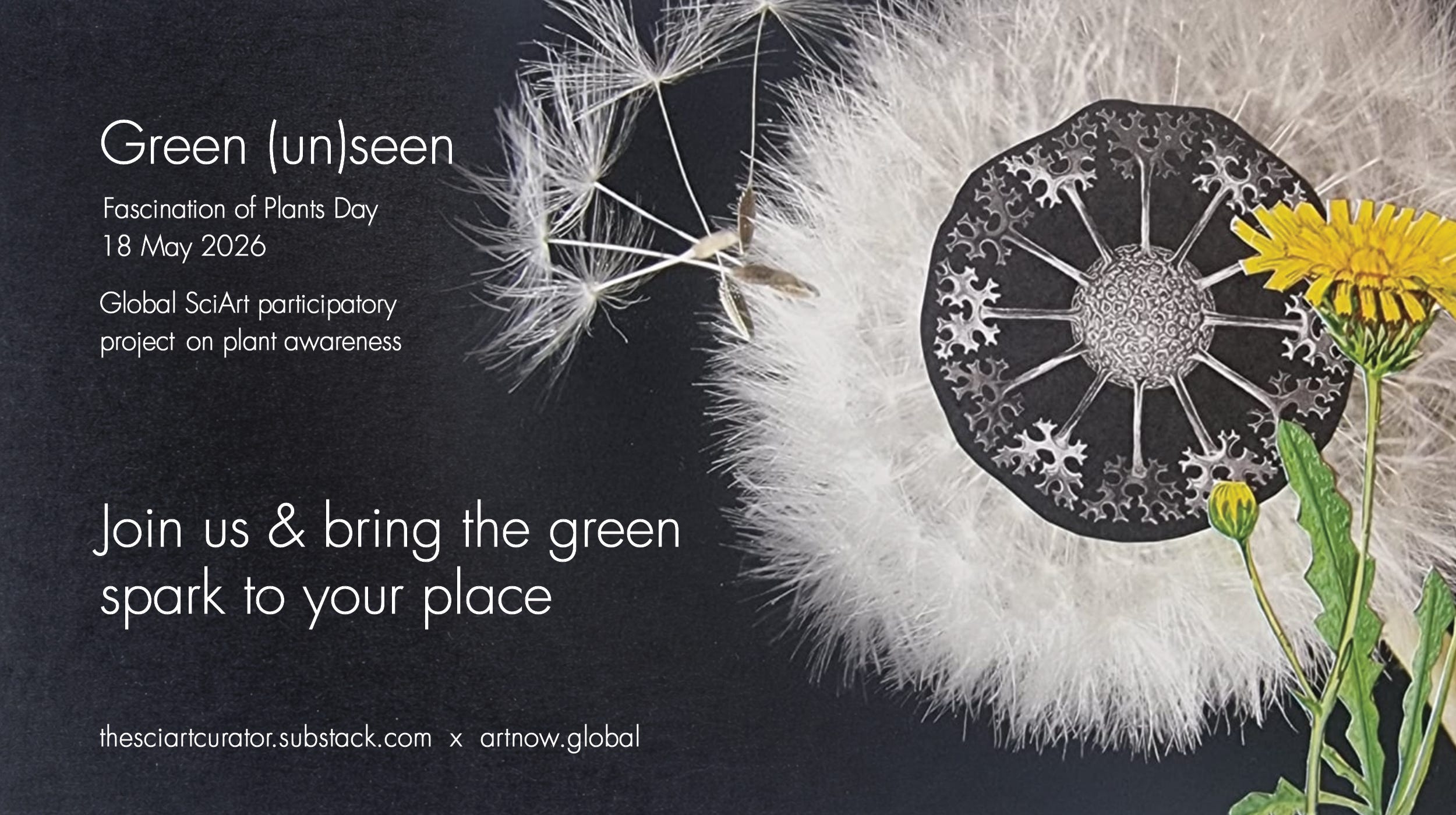
Yay! Huge thanks, Lindsay, for helping us spread the word about Green(un)seen. This means A LOT 💚🌿.
To the 100DayProject community: You are very welcome to take part in this growing, international intervention. Please drop me a line if you would like to know more about Green(un)seen.
I am the prof at SAW! So, so proud of Jyotsna for the work she's done in class. It is incredible, and she's an amazing source of wisdom to have in live classes!!!