
Day 81: Change happens slowly
time is your side

Hello, friends—
A lot of us imagine creative growth as some dramatic breakthrough moment. But more often it happens so slowly it’s almost invisible at first. You keep showing up and one day you notice something is different. Maybe your skill improved, or your taste, or maybe you just feel different.
Or you put two paintings side by side and wow.
Today’s interview comes from Katie Crepeau, with thanks to Tricia Fell for the thoughtful questions. Katie talks about rebuilding a creative practice after years where work, parenting, and responsibility took up most of the space, and how she found her way back through practices like The Artist's Way and this project. A good reminder that no matter how long the break, you can always return.
You came back to the 100 Day Project after nine years. What was different about showing up this time, and what does that gap tell you about where you are in your creative life now?
Nine years is a big gap! A lot has changed in my life since then. Nine years ago I was a new parent living in London and I did The 100 Day Project to stay connected to my sister. We co-authored a story for my first daughter that year.
This time around, I’m ten years into parenting two children, back in the US, and made a few career changes. I worked a corporate consulting job for five years, and during that time my creativity took a big dip. By the end of that chapter, I was feeling unwhole. Something fundamental was missing.
I noticed I was consuming a lot—reading a ton, watching shows, and absorbing a lot. I was also caught up in an output-focused work environment. The creative part of me, the part that gives me so much energy, had gotten so tiny. Parenting and corporate consulting were the two dominant forces in my life, and there wasn’t any room for creating and making.
So I did The Artist’s Way program last year and it helped me immensely in reconnecting with my creative self. Over the past year and a half I’ve rebuilt my art practice, and it feels so GOOD. I feel more whole, more alive. Even my kids now tell people, “My mom is an artist.” Before 2025, I would have never used that title.
Now I’m owning “artist”. My creative practice is becoming a habit. Most days I do something creative, whether that’s drawing, painting, sketching, or handwriting. It’s become essential, like sleeping, eating, drinking water.
That gap, and the maturity that has come with it, has given me a sense of ease with the creative part of my life. I protect the time because it’s essential, but I let it ebb and flow with other things I have going on—parenting, work, family, friends, travel.
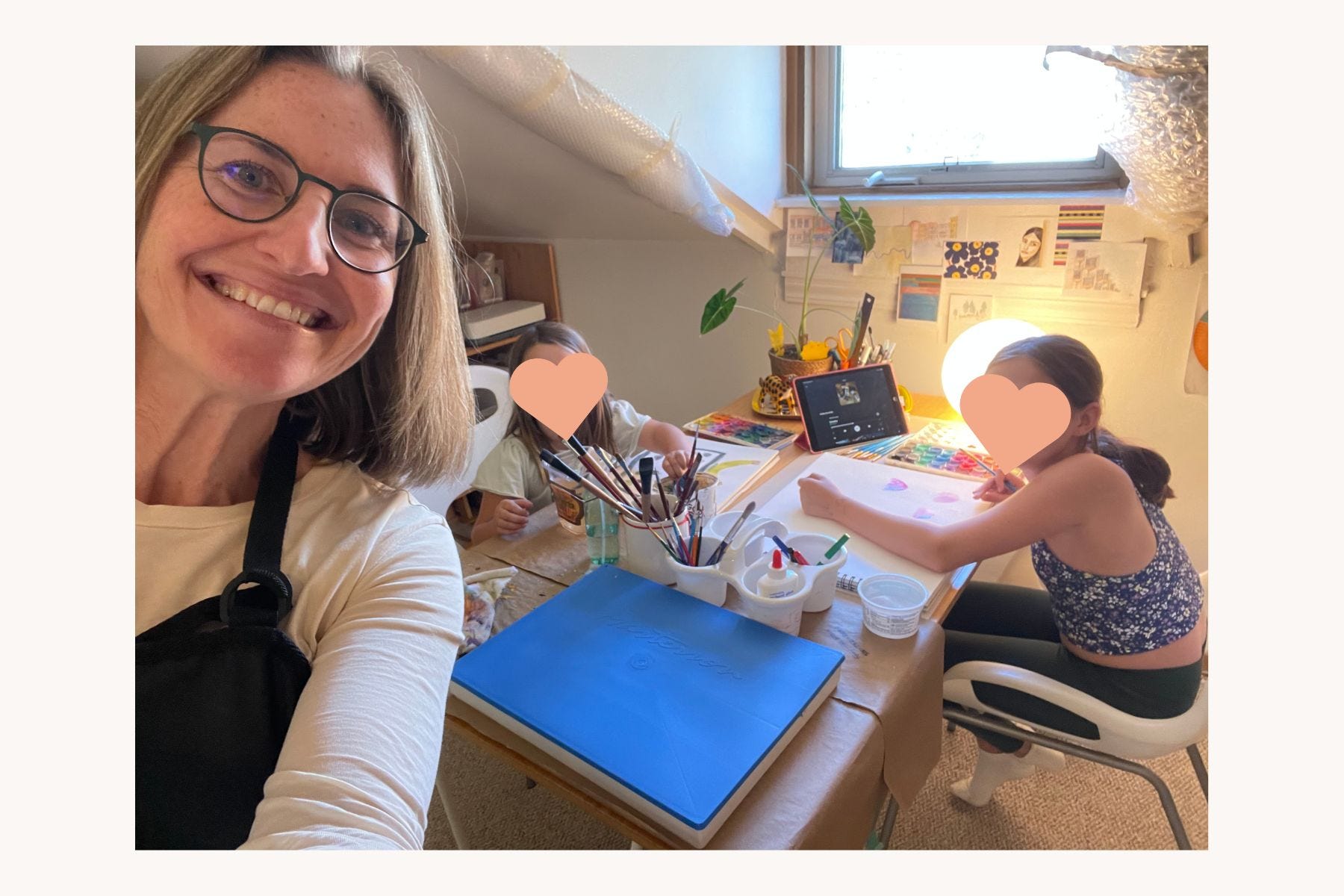
You wrote about the challenge of decoupling your identity from your paid work—from things that have to “earn” something. How has doing this project purely for process, not product, pushed on that?
That is a deep question, and one I am still wrestling with. Art is such a life-force of energy for me that I don’t want to tie it to income yet.
I have habits and mental modes from 20+ years as an architect and consultant that tie time and output to money, and I’m working to reframe my relationship to that. So I’m intentionally and consciously making art about the process. I won’t deny that I feel immensely proud when I make a piece I really love, after putting so much time and energy into it. But I’m learning to love more the process of showing up to my easel, putting on my painting apron, looking at a blank canvas with so much possibility, and creating something new. That’s what I want to preserve: the feeling of enthusiasm and pure joy for the creative process.
Grounding myself in the creative process is seeping into my consulting work too, which I really like and want to feel more of. I notice how the journey we take with a client is where the learnings and transformation happen. Documents, reports, and assets are the time capsule of that journey. This helps me have less attachment to outcomes and outputs and more energy towards the process and practice.
When you put Day 1 and Day 60 side by side, you seemed genuinely surprised by how far you’d come! Now that you’re near the end, what do you think this project will actually be a record of? What do you hope to see when you look back in another nine years?
I see this project as a record of the creative habit I’ve built over these couple years. Having creativity as part of my daily routine is so rewarding and fulfilling, and a privilege to do. I want to see it as a celebration of the time and energy I’ve put into making it an essential part of my life.
In nine years, I hope to see the joy and enthusiasm I have right now. And the stamina! To stick with something for 100 days is a FEAT. Something each and every one of us participating needs to celebrate.
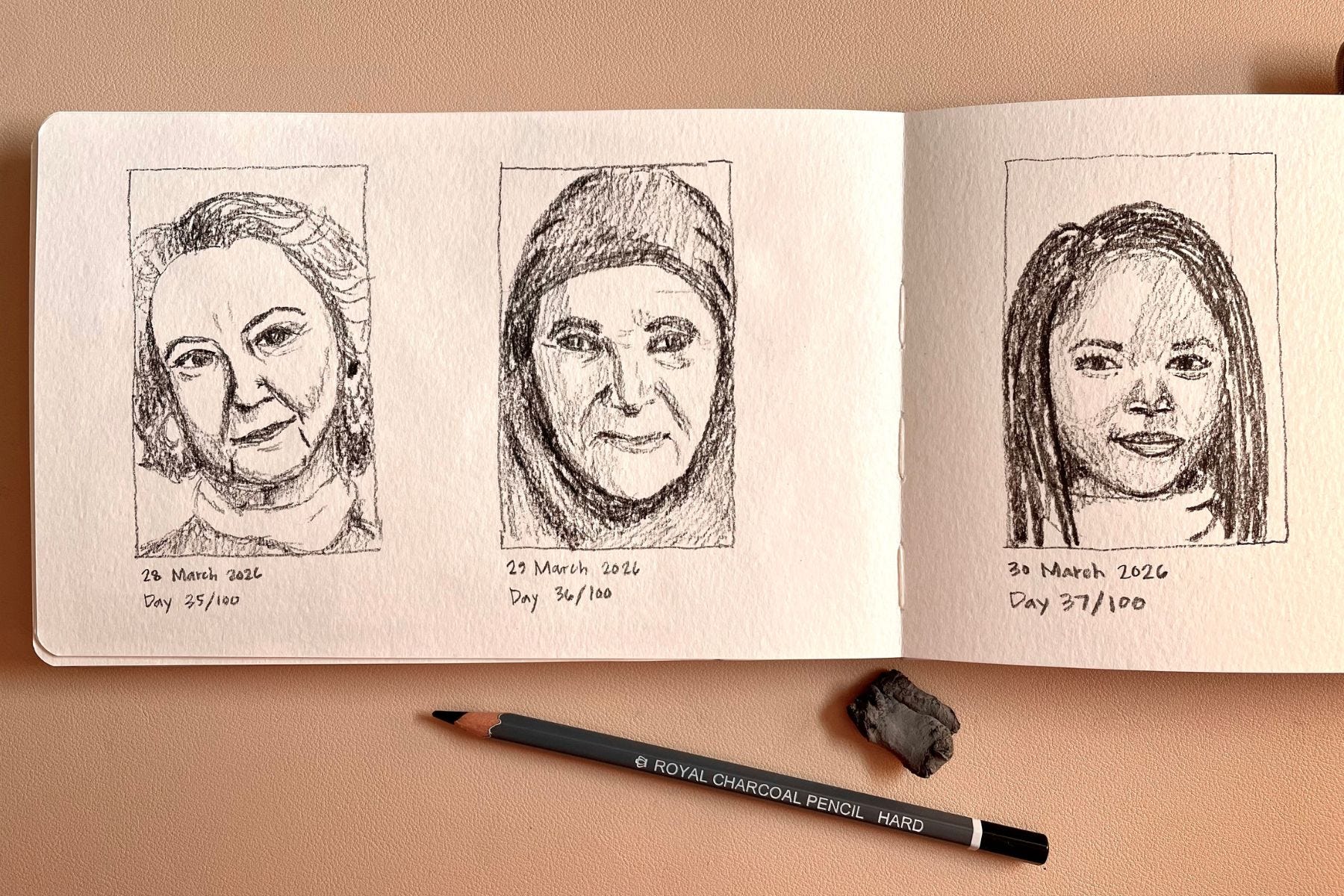
Your practice has had to bend around real life: kids in the studio, exhaustion, charcoal on weekends instead of paint, etc. What does keeping creativity alive actually look like beyond 100 days?
Through all the bending and adapting with real life, I’ve kept Bree Groff’s Most Days theory in mind: show up and do your best most days. The days when I don’t have the energy or time (exhaustion, camping, chaperoning a kindergarten field trip), I call it in and recover for the next day.
That mental shift has helped me keep showing up and doing something that keeps my creative flame stoked. I think of it like getting back to exercise: put the outfit and shoes on, and take a step. That’s what I plan to continue: keep my creative practice going, whether it’s 5 minutes or 5 hours. What matters is showing up day after day (even if you skip one here and there).
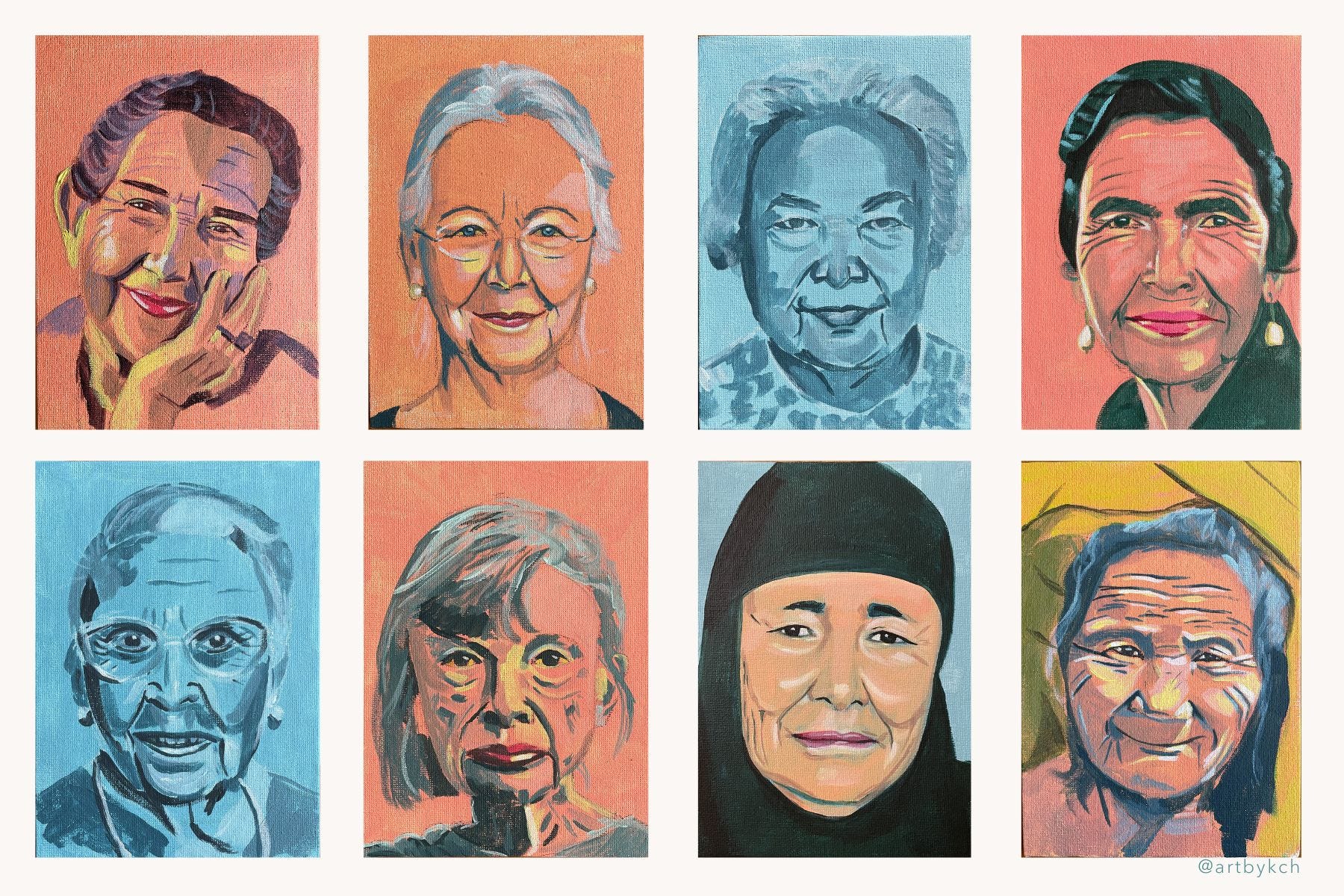
You’ve painted people with wrinkles, from six continents, with and without your glasses. What have all these faces taught you—about them, or about yourself?
I care deeply about people, and I’m always looking to bring out the gold in others. Painting portraits has reminded me of the stories, joys, heartache, and challenges each of us carries inside—the things that make us human. Our faces—with all the expressions and features—tell that story.
Painting has also helped me slow down and appreciate the beauty, diversity, and commonalities we share. Looking at the portrait of the icon Joan Didion next to a radiant Guatemalan woman reminds me that we’re all in this together. Our experiences and energies are all intertwined.
Creating a portrait of someone—no matter if they’re famous or not—is a chance to capture the brightness of each person when they are seen and celebrated. And let their portrait tell their unique story.
Thank you, Katie Crepeau, for sharing with us today. You can follow Katie here on Substack or on Instagram @artbyKCH.
FOR YOUR PROJECT TODAY
Put an early piece beside a recent one. What’s different? What feels looser, or more confident, or more you?
And maybe most importantly: what have you learned about how you work?
FOR INSPIRATION
Katie’s portraits remind me that repetition changes the way we see—not just the subject, but ourselves.
SHARE IN THE CHAT
What’s something that feels easier, more natural, or more you now than it did on Day 1? Or: what surprised you when you looked back at earlier work?
XO,
Lindsay
Thank you so much for the invitation and space to share my creative journey. This round of 100 Days is so special in many ways! I'm also grateful to all the other artists who inspire me to keep going, experimenting, and showing up.
This was so fun to read. Thank you for sharing your journey and for the idea to put an early and more recent piece side by side to reflect on what has changed in the process, not just the outcome.